Where Is Vision Formed?

When we look at the world, it seems as if our eyes are seeing. In reality, the eyes only collect light, while visual perception itself is formed in the brain. It is there that light signals are transformed into images, shapes, colors, movements, and meanings. Vision is the result of a complex, multi-level operation of the nervous system.
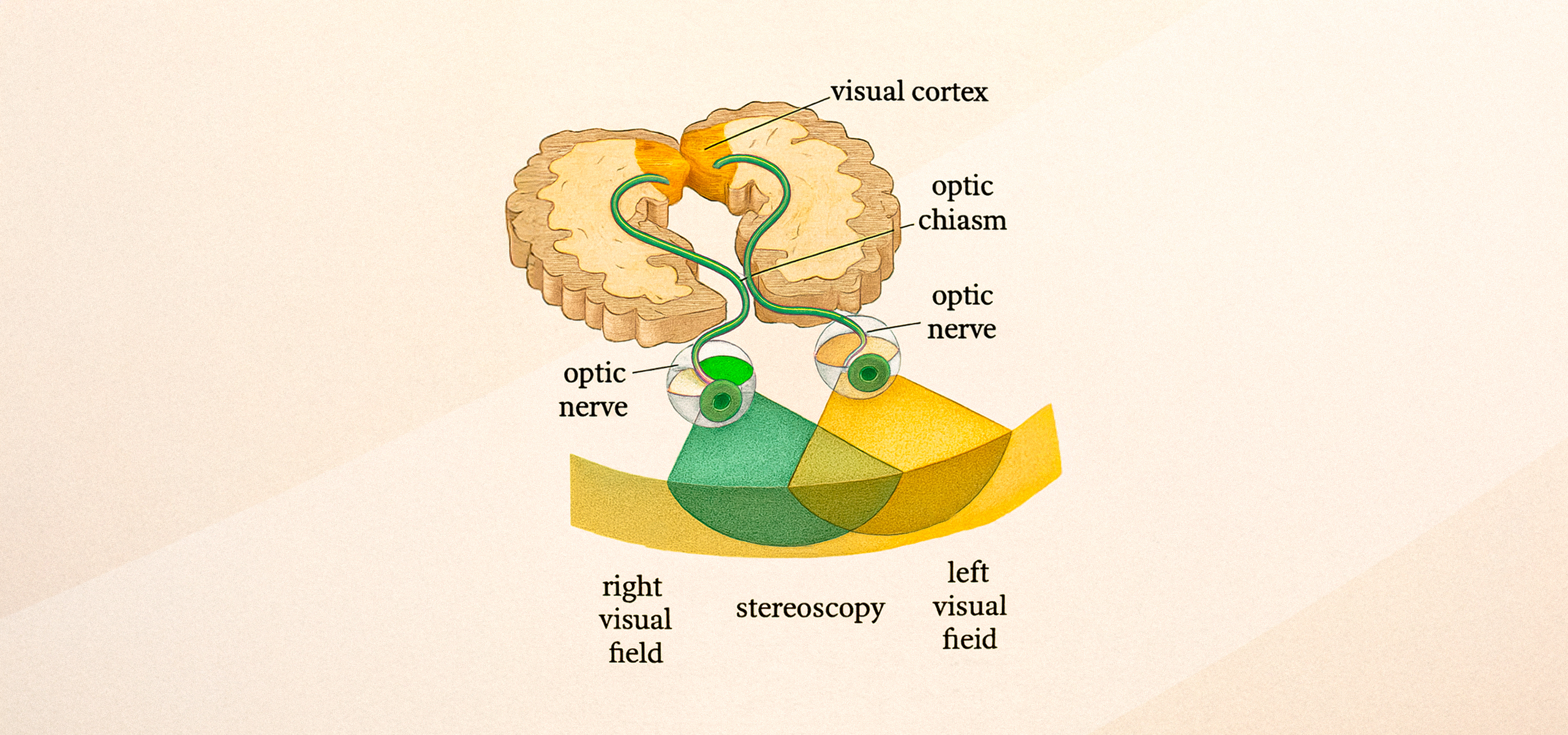
Where in the Brain Is Visual Information Processed?
The main site where visual perception is formed is the occipital lobe of the cerebral cortex. In its posterior part lies the primary visual cortex (V1). This is the first place where information from the eyes is received.
Processing does not end here. The visual cortex consists of several areas (V1, V2, V3, V4, V5), each responsible for a specific aspect of the image:
- V1: recognizes lines, contours, and object orientation
- V2 and V3: analyze shape and depth
- V4: responsible for color and complex forms
- V5 (MT): specializes in motion perception
In addition to the occipital lobe, vision involves:
- Parietal lobe: helps determine the spatial location of objects
- Temporal lobe: responsible for recognizing faces, objects, and symbols
Vision is not a single point in the brain but a distributed system.
How Visual Stimuli Are Transmitted and Processed in the Brain
The process begins in the retina of the eye. Photoreceptors (rods and cones) convert light into electrical signals. These signals are transmitted to the brain via the optic nerve.
The pathway proceeds as follows:
- The optic nerve carries information from both eyes
- At the optic chiasm, some fibers cross over
- Signals reach the lateral geniculate nucleus of the thalamus, an important relay
- From the thalamus, the information is sent to the primary visual cortex
At each stage, the signal is not simply transmitted but filtered, enhanced, and structured. The brain already begins to highlight important information and discard the unnecessary.
How the Brain Assembles a Complete Picture from Fragments
No single brain region sees the whole picture. One neuron may respond only to a line at a specific angle, another to motion, and a third to color.
The brain:
- assembles these fragments
- compares them with memory
- fills in missing details
- adjusts the image according to context
This is why we can recognize faces in the dark, read text with errors, and perceive optical illusions. Vision is not a photograph of reality but an interpretation created by the brain.
Where Is Vision Formed in the Brain?
Visual perception begins in the primary visual cortex (V1) of the occipital lobe and is then processed in areas V2–V5, the parietal, and temporal lobes for recognition of shape, color, movement, and objects.
How Are Visual Signals Transmitted to the Brain?
Light is converted by retinal photoreceptors into electrical signals, which pass through the optic nerve and thalamus to the primary visual cortex for further processing.
Unlock a new perspective. Read our latest guide on Blind People Facts.
Which Brain Areas Are Responsible for Color, Motion, and Shapes?
- V1: lines and contours
- V2/V3: shape and depth
- V4: color and complex forms
- V5 (MT): motion
Why Does the Brain See an Interpretation Rather Than a Photograph of the World?
The brain combines fragments of information, compares them with memory and context, and fills in missing details. Therefore, vision is always a meaningful perception, not an exact copy of reality.
Conclusion
Vision is a multi-layered system of information processing: from ancient centers that respond to light and motion to the highly organized cortex capable of recognizing faces, reading text, and interpreting symbols. We do not simply see; our brain continuously calculates, compares, completes, and gives meaning to the visual world.